Google Cloud Outage:
Lessons for Business Resilience
Introduction
Incident Duration
On 20 October 2026, an electrical power disruption at a facility supporting Google Cloud’s London region affected cloud workloads and services across the UK. According to Google’s updated incident report, the main disruption lasted six hours and eight minutes. Although the power loss occurred in one availability zone, some services operating across the wider region also experienced errors and delays.
The incident highlights a wider challenge for businesses relying on interconnected technology: resilient individual systems do not automatically guarantee that an entire business service will remain available.
Understanding the dependencies between infrastructure, applications and third-party services is therefore essential to effective continuity planning.
What caused the Google Cloud London outage on 20 October 2026?
The outage explained
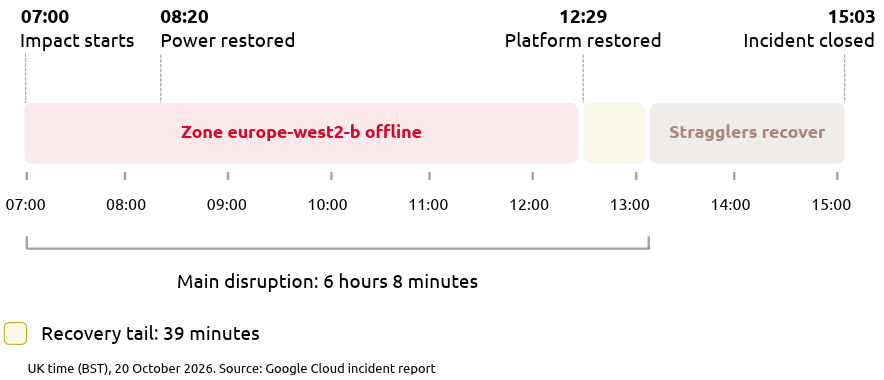
Google’s investigation identified an external underground cable fault that interrupted a primary utility power feed at a facility hosting its Europe-west2-b availability zone.
At the time, the facility was operating in a temporary single-feed configuration while maintenance was under way on another feed. A misconfiguration in the generator control logic meant the backup generators did not start automatically when the active feed failed. The uninterruptible power supply (UPS) batteries provided temporary power but were depleted before a sustained alternative supply was established.
The power loss made resources in Europe-west2-b unavailable. Google reports that redirected demand strained unaffected zones, and cross-zone control-plane dependencies also contributed to timeouts and elevated errors. Some regional and multi-zone services therefore experienced disruption even though the original power loss was confined to one zone.
Google identified affected products including Compute Engine, Google Kubernetes Engine, Cloud SQL and Cloud Pub/Sub, although the nature and extent of impact differed by product and configuration. The primary incident ran from 07:00 to 13:08 BST. Google also reported that some individual workloads took longer to recover.
The effects were visible to users outside Google Cloud itself. Reuters reported disruption to Revolut services, while Associated Press reported that Lloyds, Halifax, and HSBC were among the banks reporting problems that day. These reports should not be read as proof that every customer-facing problem had an identical technical cause.
Hidden dependencies
How hidden dependencies turn one failure into many
Business operations rarely depend on a single application. A customer-facing service may rely on identity systems, databases, APIs, payment services and other infrastructure operated by different suppliers. Each component can have its own recovery arrangements, yet the business process still depends on them working together.
Consider an online shop whose website remains accessible while its payment integration becomes unavailable. Customers can browse products but cannot complete purchases. Similarly, employees may be unable to use an otherwise operational application if they can’t reach the authentication service.
Example: An interrupted online purchase
Online Shop
Available
Payment API
Unavailable
Checkout
Interruption
In both examples, the most visible application has not necessarily failed. The interruption occurs in a service it depends on. This matters because organisations may have limited direct control over third-party infrastructure while still carrying responsibility for the consequences of interrupted operations.
As organisations adopt more cloud services and integrations, mapping the systems that support critical business processes becomes increasingly important. Without the visibility, it is difficult to assess the consequences of a failure or design an effective recovery plan.
Related reading: How to connect secure cloud systems
Availability vs continuity
Cloud availability vs business continuity: what’s the difference?
Cloud providers offer resilience capabilities such as redundant infrastructure, multiple availability zones and failover options.
However, their effectiveness depends on how individual workloads are designed and configured, the capacity available during an incident, and the dependencies shared across services.
The October incident provides a specific example. Google reported both capacity pressure in unaffected zones and dependencies across zone boundaries. It also noted that customers using zonal resources must configure recovery arrangements appropriate to their needs.
Infrastructure recovery and business recovery are not necessarily the same thing.
Restoring a server or database does not automatically restore the business process it supports. Recovery plans must account for application connections, identity services, data consistency, third-party services and the ability to continue essential operations while restoration is under way.
Three layers of business resilience
Infrastructure
Ensuring critical systems have appropriate redundancy, backup and recovery arrangements.
Dependencies
Understanding how applications, integrations and third-party services rely on one another.
Business Continuity
Planning and testing how essential business operations can continue or recover during disruption.
Cloud diversification
Is multi-cloud or an alternative UK cloud provider the answer?
The outage does not establish that smaller cloud providers are inherently more reliable than hyperscalers. However, it highlights the importance of examining concentration risk, particularly where multiple critical services depend on the same provider or underlying infrastructure.
Diversification may involve hosting selected workloads with another provider, introducing independent backups or improving failover and recovery arrangements. While using multiple providers can reduce certain risks, it can also add cost, complexity and operational dependencies. The appropriate approach depends on an organisation’s requirements and the risks it needs to address.
For financial organisations within its scope, the EU’s Digital Operational Resilience Act (DORA) also makes ICT third-party risk management a regulatory consideration. Applicable since 17 January 2025, DORA includes requirements relating to ICT third-party dependencies and concentration risk.
As Responsiv’s Preparing for DORA briefing explains, relying on a limited number of providers can create concentration risks, while distributing services across multiple suppliers introduces additional management and oversight challenges.
DORA does not impose a general requirement to adopt a multi-cloud strategy. The objective is not necessarily to use more providers, but to understand critical dependencies, assess the associated risks and establish appropriate resilience and recovery arrangements.
How Responsiv can help
For businesses reassessing where and how they host critical systems, Responsiv offers UK Sovereign Cloud Services built around data residency, infrastructure control and UK-based support.
Responsiv Cloud operates on dedicated, single-tenant infrastructure, with production and backup data held entirely within the United Kingdom. The cloud service is provided by a UK company under English law, without a non-UK parent company or reliance on hyperscaler platforms for delivery.
Responsiv maintains control of its encryption keys, restricting its infrastructure provider’s ability to decrypt customer data using those keys. Physical access to the underlying hardware is restricted to UK-based personnel.
These arrangements provide greater clarity over where data is held, who operates the infrastructure and how access is controlled. While no cloud provider can eliminate the possibility of an outage, Responsiv Cloud offers an alternative hosting model for organisations looking to diversify their infrastructure.
Alongside cloud services, Responsiv provides integration, automation and technical support expertise to help organisations understand system dependencies, assess existing environments and identify opportunities to improve resilience.
Reviewing your cloud infrastructure or considering alternative hosting arrangements?
Contact Responsiv to discuss your requirements and available options.
Key lessons from the Google Cloud outage
Conclusion
The October outage is a reminder that even the largest technology providers are vulnerable to unexpected failures.
For businesses, the important question isn’t whether a cloud provider can guarantee that nothing will go wrong. No provider can. It’s whether the organisation understands its dependencies, has considered the consequences of a failure and has the arrangements in place to recover.
Concentration risk should be assessed alongside the benefits of cloud services. A different provider, region or backup system only improves resilience when it addresses a real failure scenario and is supported by an effective operating and recovery plan.
Cloud resilience starts with infrastructure.
Business resilience depends on everything connected to it.
Five key questions to ask
Speak to Responsiv
Explore your cloud hosting options
Whether you’re reviewing you existing cloud environment, considering alternative hosting or looking to understand critical dependencies, our team can help you explore your options.