Introduction
Organisations of every industry, type and size are increasingly turning to cloud to manage operations and IT infrastructure. Typical use cases include data analytics, data backup, disaster recovery, and customer-facing web applications.
The cloud gives organisations access to a broad range of technologies that provide flexibility to meet business demands, insight into data stored to make business decisions, increased collaboration as teams can view and share information easily, and more.
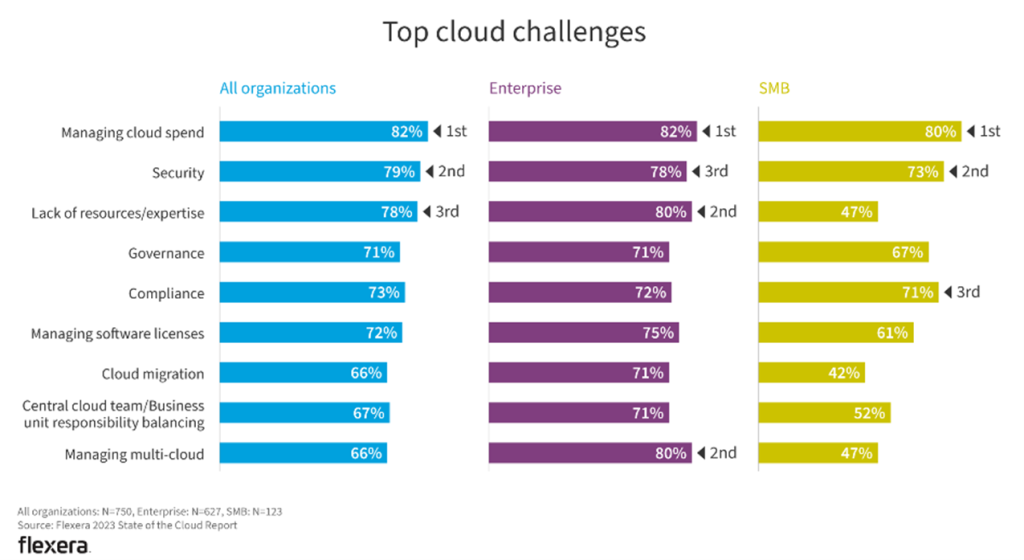
Whilst the cloud offers multiple benefits, organisations are facing multiple challenges. The Flexera State of the Cloud report finds that out of 750 cloud decision makers, 82% of those find managing cloud spend their top challenge, with security coming second at 79%, and lack of resources/expertise coming in third at 78%.
This POV will explore the top three cloud challenges and how to mitigate them.
Challenges and Solutions
The cloud industry is growing at a rapid pace, with new tools and technologies being implemented by more and more organisations. The options available for cloud providers, hosting, and services are abundant, and organisations sometimes are unaware of the cloud environments they are running.
We have a single cloud strategy, but actually we are multi-cloud due to these SaaS applications we have.
As the options for cloud grown, so do the challenges and risks associated with using cloud services.
This section will be exploring the top 3 challenges associated with cloud in 2023 and how organisations can combat to stay ahead.
1 – Managing Cloud Spend
The cost of cloud has taken the top spot for the biggest challenge for all organisations, big and small (SMBs and Enterprises).
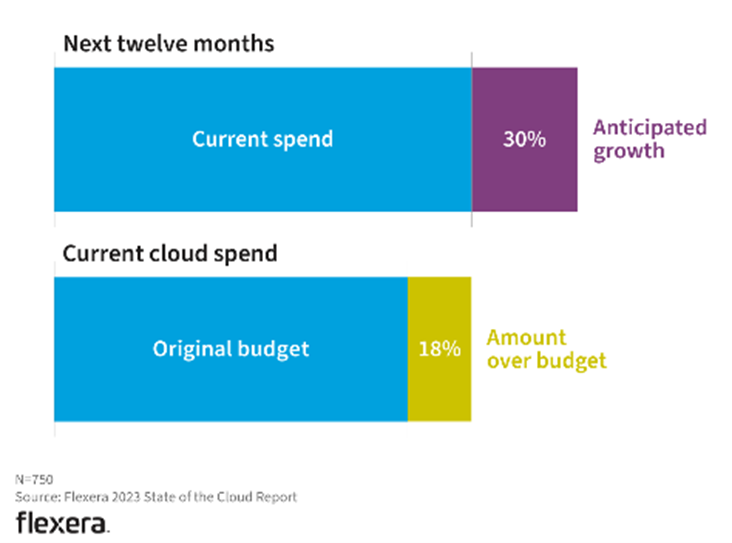
Research found that on average, organisations are 18% over their cloud spending budget, with this number anticipated to increase another 30% in the next 12 months.
Cloud services often use a pay-per-use pricing model where costs are incurred based on usage. This could be the amount of data transfer, storage, or computing power.
The on-demand and scalable nature of cloud computing services can make it difficult to predict costs if the environments and users are managed incorrectly or inefficiently. Without careful monitoring, cloud bills can quickly become difficult to predict and define, making budgeting near-impossible as costs jump around under normal and spate conditions. If done manually, it could take years to understand the trends in usage, and that is only if the data is available to understand the factors that lead to more or less usage and costs.
Managing cloud spending involves the analysis, tracking, and optimisation of expenses associated with cloud services and infrastructure so organisations can remove any wasteful spending. Organisations can mitigate this challenge with cloud spend management strategies and tools that allow them to identify cost saving opportunities, control cloud usage, improve compliance measures, and better allocate resources.
Utilising cloud cost management resources provides multiple advantages, such as precise forecasting of cloud computing requirements and anticipating unforeseen increases in expenses. Tools like this also empowers teams to monitor and analyse cloud spend data and understand usage patterns to identify areas that need cost optimisation. Ensuring cloud resources are matched to actual workload capacity needs at the lowest cost should be an ongoing task to remove cost inefficiencies.
IBM Turbonomic
To avoid disruption, you might end up provisioning more resources, such as memory, CPU, and storage than needed, resulting in a bloated cloud bill and a disappointing ROI. This can be combatted with IBM Turbonomic.
IBM Turbonomic is an AI-powered solution for effectively managing cloud deployments and aligning application demand with infrastructure availability for the most efficient use of the existing capacity.
This cloud cost management tool automatically halts, initiates, and relocates applications in response to demand. It uses stored data to train AI for future decisions.
With IBM Turbonomic your organisation can unlock all of its applications’ potential without impacting your environment by providing:
- Cloud cost optimisation
- Data centre optimisation
- Kubernetes optimisation
- Sustainable IT
The tool seamlessly integrates with various processes, tools, and workflows to maximise its capabilities, and provides full stack visualisation to ensure cost-effective resourcing decisions are made to lower the cloud bill throughout your entire environment.
2 – Cloud Security
Although cybersecurity is not the top concern for Enterprises (coming third), it is the overall second priority for all organisations and the SMB category.
Crime targeting cloud environments is on the rise as the industry and use increases.
The main challenges facing cloud security include misconfigurations that leave data and access exposed, limited visibility of the full cloud environment, human error if processes are not built or followed correctly, and unmanaged attack surfaces that can expose IT infrastructure.
Cloud security serves as a framework for an organisation’s security posture. It allows companies to take advantage of the flexibility of cloud services, without putting confidential data at risk. By default, most cloud providers have security practices implemented, but organisations need to take responsibility for protecting data, workloads, and applications on the cloud.
There are many solutions that organisations can utilise to ensure their cloud environment is secure. These include identity and access management (IAM) tools that control the management and access of resources, security information and event management (SIEM) tools which automate monitoring, incident response and detection of threats, and data loss prevention (DLP) tools that provide visibility to the data stored in cloud environments.
Responsiv Cloud Security Service
The Responsiv Cloud Security Service is pre-integrated with all Responsiv Cloud Platforms to provide robust and comprehensive security functionality.
- Locally manage users
- Connect to external identity providers for Single Sign-On
- Create federated trust associations
Access controls can be set according to roles, users, attributes, or context and time, providing flexibility when assigning privileged access to you systems, data, and processes.
Responsiv Consulting
Responsiv Consultants have expert knowledge of configuring cloud environments. This can be utilised by organisations to ensure the risks of misconfiguration are mitigated, limiting this critical attack vector.
IBM Guardium
IBM Guardium is a comprehensive database security monitoring tool that helps to prevent data leaks form data warehouses, databases, and big data environments. It is built on architecture that is scalable and provides full visibility on all data and associated activity. It allows organisations to control their data environments on a granular, file-by-file level and can open alerts/tickets when certain data is accessed.
IBM Randori
IBM Randori is an attack surface management solution, using continuous, automated testing until it finds a way in or identifies a threat. It scales to test access and new vulnerabilities to provide assessments of cybersecurity strengths and weaknesses. Randori uses continuous asset monitoring, shadow IT discovery, risk-based vulnerability prioritisation, and enterprise integrations and reporting to detect abnormalities in an organisation’s attack surfaces and IT infrastructure.
3 – Lack of Resource Expertise
The need for cloud expertise and resources continues to grow alongside cloud adoption. Research found over 85% of surveyed IT professionals expressed a lack of skills in cloud computing. It is a specialised field, and not everyone is skilled in it. Where
there is a lack of expertise, organisations may struggle to set up and maintain their cloud systems, alongside keeping their data secure, and ensuring cloud resources are cost effective.
For efficient cloud utilisation there are many skills that are required, including architecture and design, networking skills, platform-specific skills, and data management.
Organisations look to solve the cloud skills gap through recruitment, upskilling staff and training programmes. However, research shows that 44% of 304 organisations see a difficulty in finding qualified candidates. Hiring full time staff is not the only option for organisations to find resources.
Instead of finding in-house cloud operations, organisations can consider leveraging cloud managed services that offer expertise in cloud management. Service providers take over some or complete control of cloud-related operations, allowing organisations to focus on core business. Partnering with cloud experts will ensure efficient control of security, compliance, and services without the costs of hiring candidates.
Other benefits of using managed services include cost saving due to subscription-based pricing centred around requirements, access to expertise and skills and remote monitoring and management to avoid downtime.
Responsiv Assist
Responsiv Assist is our remote technical support offering. We provide expert skills, ad-hoc, using a credit-based ticket system. Our support offerings cover the entire lifecycle of an IT project, from development skills and go-live support to on-going support, training, and managed services.
All Responsiv Cloud Platforms are provided as a managed service, meaning we host, secure, manage, and develop cloud native solutions to simplify how you deliver technology benefits to your business.
Use Responsiv Assist for access to expert knowledge in a vast range of technologies and products.
Responsiv Consulting
Responsiv Consultants are available for resource augmentation, project delivery, process development, cloud migration, and more.
Our consultants can be procured on a part- or full-time basis to support your in-house teams in delivering strategic and non-strategic IT projects. Our asset-based approach provides access to delivery methods and expertise, as well as technology assets including industry-leading middleware, software, and solutions.
Use Responsiv Consulting to augment the expert skills you don’t have in-house.
Conclusion
Utilising cloud is becoming more popular for organisations, and as adoption grows, organisations are reaping the benefits. However, this adoption comes with challenges. It is important for organisations to take measures to understand these challenges and understand how to mitigate them if they occur.
To remain cost-effective, secure, and efficient, organisations should take a strategic approach to reduce the potential risks of cloud adoption. Being aware of the risks and how to mitigate them is vital for organisations to take advantage of the benefits of cloud, without any unprecedented surprises.
Get in touch today to talk about your cloud strategy in 2024!